What Exactly Is a Mortgage Pre-Approval?
Think of a pre-approval as a financial snapshot — it shows lenders, sellers, and you exactly where you stand.
When you get pre-approved, a lender reviews your finances and says,
“Based on your credit, income, and debts, we’d be comfortable lending you up to this amount.”
To do that, they’ll ask for:
✅ Recent pay stubs or income proof
✅ W-2s or tax returns
✅ Bank statements
✅ Authorization for a credit check
✅ Info on any debts (student loans, car payments, credit cards)
Once reviewed, you’ll receive a pre-approval letter that states how much you’re qualified to borrow, what type of loan fits best, and how strong your buying position is.
That letter is your golden ticket — it tells sellers you’re not just looking, you’re ready.
Pre-Approval vs. Pre-Qualification: Not the Same Thing
People mix these up all the time, but the difference matters.
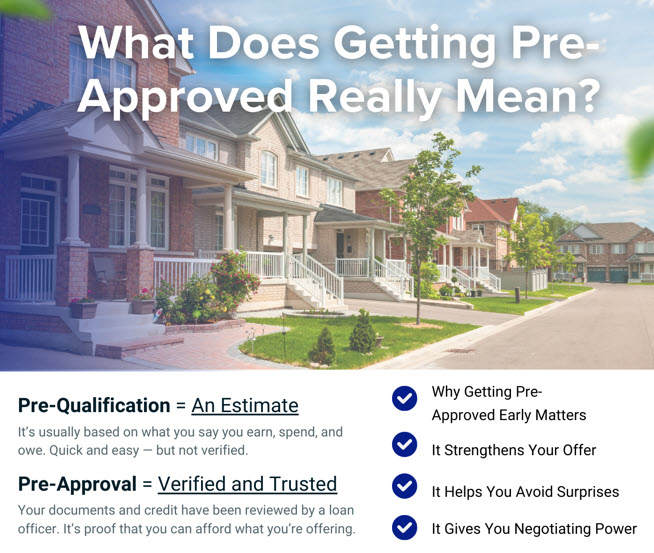
Pre-qualification = an estimate.
It’s usually based on what you say you earn, spend, and owe. Quick and easy — but not verified.
Pre-approval = verified and trusted.
Your documents and credit have been reviewed by an actual lender. It’s proof that you can afford what you’re offering.
If you plan to make an offer anytime soon, pre-qualification isn’t enough. Pre-approval is the version sellers take seriously.
Why Getting Pre-Approved Early Matters
There’s a world of difference between “I’m looking” and “I’m ready to buy.”
Here’s what pre-approval does for you.
1️⃣ It Defines Your Real Budget
Online calculators are fine for fun, but they don’t account for your actual debts, credit score, or local taxes.
A pre-approval gives you the real numbers — what you can comfortably afford, not just what you hope you can.
That helps you focus on homes that fit your life and financial comfort zone, not just your wish list.
2️⃣ It Strengthens Your Offer
In today’s market, sellers want confidence.
A pre-approval letter says you’ve already cleared the biggest hurdle — financing.
That makes your offer more competitive, even against higher bids. It shows you’re serious, verified, and ready to close.
In short: it turns your “maybe” into a “yes.”
3️⃣ It Helps You Avoid Surprises
Pre-approvals can reveal small issues before they become big headaches.
Maybe your credit score needs a boost.
Maybe your debt-to-income ratio (DTI) is a little too high.
Maybe there’s an error on your credit report that needs fixing.
Catching those early gives you time to correct them — not panic about them the week before closing.
Sometimes, a good lender can even help you adjust your plan to qualify for a better rate or higher approval amount. That’s valuable insight before you start making offers.
4️⃣ It Gives You Negotiating Power
When a seller sees “pre-approved” next to your name, they know you’re a real contender. That confidence can help you:
✅ Negotiate better terms
✅ Compete with cash buyers
✅ Close faster when you find “the one”
In a competitive market, being prepared isn’t just smart — it’s strategic.
What a Pre-Approval Isn’t
Let’s kill a few myths:
🚫 It’s not a guarantee.
A pre-approval means your finances check out so far. Final approval still depends on the property, appraisal, and updated documentation.
⏳ It doesn’t last forever.
Most pre-approvals are good for about 60–90 days. If you don’t buy within that window, it’s easy to update with refreshed pay stubs and bank statements.
📉 It won’t wreck your credit.
Yes, it’s a “hard inquiry,” but it usually only drops your score by a few points — temporarily.
(Pro tip: multiple mortgage inquiries within a 45-day window count as one inquiry.)
When Should You Get Pre-Approved?
Sooner than you think.
Even if you’re 3–6 months away from buying, getting pre-approved now gives you a clear roadmap — where you stand, what to improve, and how much to save.
If you’re ready to buy soon, you’ll want to be pre-approved before touring homes. That way, when you find the right one, you can move fast and confidently.
Final Thought: Pre-Approval = Power
Getting pre-approved isn’t a chore. It’s your first move toward clarity, confidence, and control.
It tells you what’s possible.
It helps you compete like a pro.
And it saves you from the stress of guessing your budget while falling in love with homes you can’t afford.
So before you start imagining paint colors or patio furniture, take this step first.
Get pre-approved. Know your numbers. Then shop like a buyer who’s ready — not just hopeful.
Want to see what your real numbers look like?